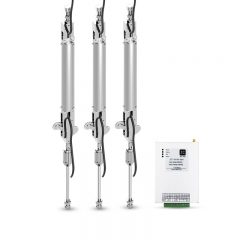
Summary: Agincourt Resources, operator of the Martabe Gold Mine in North Sumatra, Indonesia, deployed ZC Sensor’s wireless in-place inclinometer remote monitoring system (ZCT-CX300) to monitor the tailings storage facility (TSF). The system provides remote, continuous deformation monitoring with data uploaded directly to the mine’s cloud data center, supporting the mine’s zero-accident safety program. The TSF, designed to ICOLD standards and approved by the Dam Safety Commission, is one of the mine’s highest-priority safety assets.
1. Project Overview
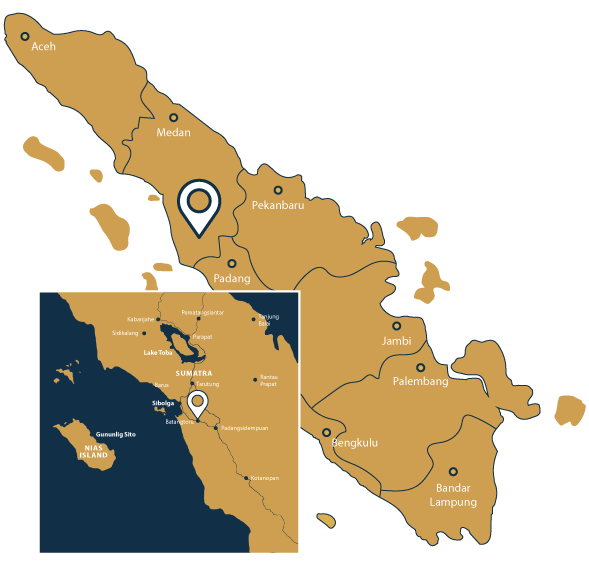
The Martabe Gold Mine, located on the west coast of North Sumatra Province in Indonesia, sits in a world-class gold region. The mine is operated by Agincourt Resources and is built around the Purnama open-cut pit — part of a mineralized area spanning up to six deposits within a 6 km radius, with both gold and silver potential.
The mine operates a conventional carbon-in-leach (CIL) processing plant with a design capacity of 5 million tons of ore per annum. All process tailings and waste are collected at a dedicated tailings storage facility (TSF) — a critical structure whose safety is a top operational priority.
Key project data:
- Operator: Agincourt Resources (strategic partner of ZC Sensor)
- Location: North Sumatra Province, Indonesia (Batangtoru Forest region)
- Mining method: Open pit (Purnama Pit), ~10-year mine life
- Processing: Carbon-in-leach (CIL), 5 million tons ore/year design capacity
- Monitoring target: Tailings storage facility (TSF) embankments
- System: ZCT-CX300 wireless in-place inclinometer remote monitoring
- Data flow: Remote monitoring with cloud data center upload
2. The Challenge: TSF Safety in a Biodiversity-Rich Region
Tailings storage facilities are among the most safety-critical structures in mining. A TSF failure can release process waste into surrounding ecosystems, threaten downstream communities, and cause catastrophic environmental damage. For the Martabe Gold Mine — located within the Batangtoru Forest, an ecosystem known for high biodiversity — the consequences of a TSF incident would be especially severe.
The TSF at Martabe was designed by internationally recognized engineering consultants, adapted to the standards of the International Committee on Large Dams (ICOLD), and approved by the Dam Safety Commission. Embankment construction is carried out under strict supervision and regular quality assurance.
Despite rigorous design, continuous monitoring is essential. TSF embankments deform over time — through settlement, seasonal water level changes, and incremental loading as new tailings are deposited. Deformation monitoring provides the earliest possible warning of developing instability, complementing the design and construction safeguards.
Agincourt Resources’ corporate commitment compounds the requirement: the company’s goal is zero accidents for employees and contractors, aligning with international best practice for health and safety performance in mining.
3. The Solution: Wireless In-Place Inclinometer System
System Architecture
Agincourt Resources implemented a safety management system for Martabe Gold Mine equipped with ZC Sensor’s wireless in-place inclinometer remote monitoring system (ZCT-CX300). The system provides:
- Remote, continuous deformation monitoring of the TSF embankment
- Automatic data upload to the mine’s cloud data center
- Real-time visibility for safety engineers without field visits
- Integration into the mine’s broader safety management framework
Why In-Place Inclinometers for TSF Monitoring
In-place inclinometers (IPIs) are a standard instrumentation choice for TSF and dam monitoring. Unlike portable traverses, which require manual survey passes, an IPI array is permanently installed in a borehole and provides continuous readings along the depth profile. This makes it possible to detect slow, deep-seated deformation that surface monitoring might miss.
- Continuous operation — no dependence on manual survey schedules
- Depth-resolved displacement data along the borehole profile
- Early detection of deep deformation before surface signs appear
- Remote data access reduces personnel exposure in the field
4. Technical Specifications
| Parameter | Specification |
| Product | ZCT-CX300 wireless in-place inclinometer system |
| Measurement | Dual-axis |
| Construction | All-stainless-steel |
| Waterproofing | Each probe tested to 150 m water depth |
| Configuration | Addressable probes on a single cable |
| Protocol | Modbus open protocol — supports networking for data acquisition |
| Data flow | Remote monitoring with cloud data center upload |
| Operation | Real-time monitoring |
| Configurations | Vertical and horizontal types available |
| Application focus | Tailings facilities |
5. Results & Impact
Zero-accident support: The continuous remote monitoring capability directly supports Agincourt Resources’ zero-accident commitment by providing early warning of developing deformation in the mine’s most safety-critical structure.
Reduced personnel exposure: Remote data upload eliminates the need for routine field measurement passes at the TSF, reducing worker exposure in an environment with inherent geological risk.
Operational efficiency: Automated data collection and cloud access reduce the cost and time of manual monitoring campaigns, allowing engineering resources to focus on analysis rather than data gathering.
Design-code alignment: The system complements a TSF designed to ICOLD standards, adding an operational monitoring layer to the design and construction safeguards.
6. Key Takeaways for Engineers
- TSF monitoring is about detecting slow, deep movement: Surface signs of TSF instability appear late. In-place inclinometers provide depth-resolved, continuous data that detects deep-seated deformation at an early stage.
- Remote capability changes the safety equation: Wireless remote monitoring reduces how often personnel must visit the structure — an important consideration for facilities in remote or environmentally sensitive locations.
- Open protocols simplify integration: The Modbus open protocol allows the monitoring system to integrate with the mine’s existing data acquisition and management platforms, avoiding vendor lock-in.
- Design standards and monitoring are complementary: A well-designed TSF (ICOLD-aligned) still requires operational monitoring. Design addresses the static risk; monitoring addresses the dynamic, time-varying risk.
7. Frequently Asked Questions
- Why use in-place inclinometers instead of portable traverses for TSF monitoring?
Portable traverses require manual survey passes and provide only snapshots in time. In-place inclinometers are permanently installed, operate continuously, and provide depth-resolved data along the borehole. This is essential for detecting slow, deep deformation in embankments before surface signs appear.
- How does the wireless system transmit data from a remote mine site?
The ZCT-CX300 system supports remote monitoring with data uploaded to a cloud data center. Depending on site connectivity, data is relayed via available network infrastructure to the mine’s cloud platform, where engineers can access readings remotely without visiting the instrument.
- What makes the ZCT-CX300 suitable for mine environments?
The probes are all-stainless-steel with ruggedized construction, each waterproof-tested to 150 m depth. The addressable design allows multiple probes on a single cable with simple assembly, and the Modbus open protocol simplifies integration with existing systems.
- Is TSF monitoring required by regulation?
Tailings facility monitoring requirements vary by jurisdiction, but international best practice — including ICOLD guidance and post-incident reviews of major TSF failures — increasingly treats continuous deformation monitoring as a core element of TSF safety management. Always verify local regulatory requirements for your jurisdiction.
TAG: