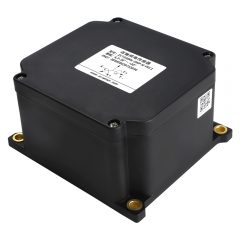
Summary: Yihai Kerry (Arawana), one of China’s largest food companies, replaced manual rack inspection with NB-IoT wireless tilt sensors on high-bay warehouse racking. The ZCT330M-series sensors detect tilt with 0.005° resolution, run 4.5+ years on battery, and trigger alarms within seconds when rack tilt exceeds configurable thresholds. The system shifted warehouse safety from periodic visual checks to continuous, real-time monitoring across two of the company’s warehouse facilities.
1. Project Overview
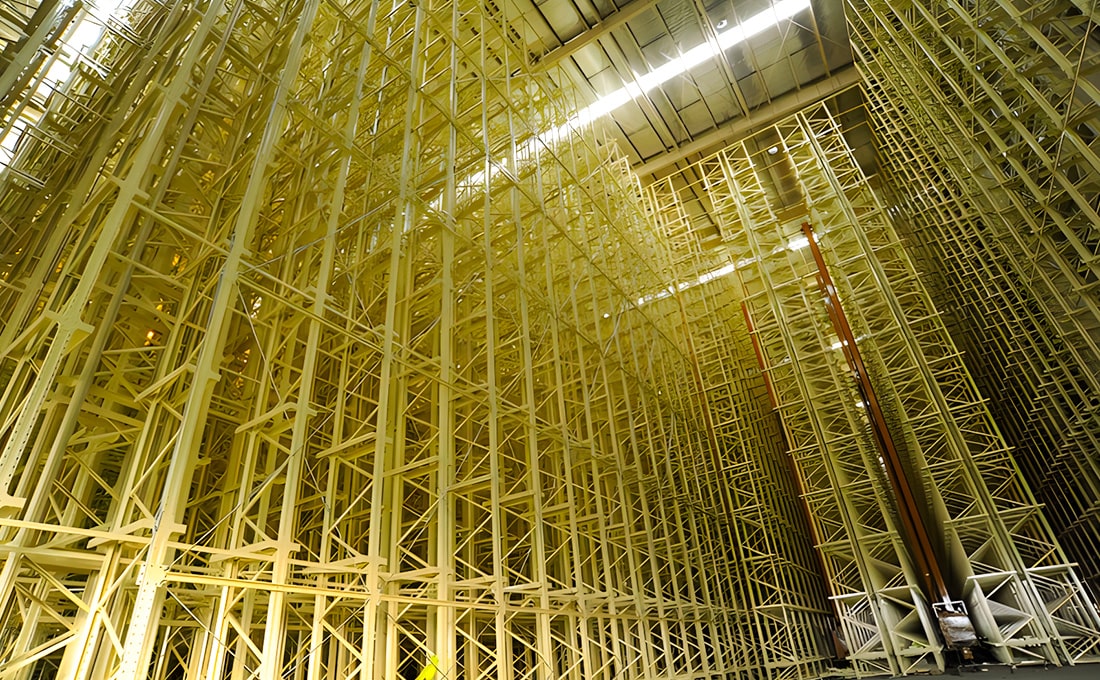
Yihai Kerry (Arawana) is one of China’s largest food companies and the country’s most recognized edible-oil brand. Its products pass through large automated high-bay warehouses before reaching retail shelves — facilities where rack height can exceed 20 meters and stored goods are heavy, dense, and sensitive to contamination or damage.
From 2023, Yihai Kerry’s warehouses began upgrading from manual rack inspection to IoT-enabled continuous monitoring. The deployment covers two key facilities: a warehouse in the Pudong Jinqiao Free Trade Zone, Shanghai, and the FengHai (Panjin) facility in Liaoning Province, which stores bulk rice and grain products.
Key project data:
- Customer: Yihai Kerry (Arawana) Group
- Facilities: Pudong Jinqiao FTZ warehouse (Shanghai); FengHai Panjin grain warehouse (Liaoning)
- Application: High-bay rack structural tilt monitoring
- Sensor: ZCT330Mx-xWP-N-YKC1 NB-IoT wireless tilt sensor
- Deployment period: From 2023
- Monitoring targets: Rack columns, beams, and top positions
2. The Challenge: Rack Tilt Invisible to Ground-Level Inspection
Food industry warehouses present a specific safety problem: as high-bay racking grows taller — in some facilities exceeding 20 meters — the structural risks grow faster than inspection capability.
Traditional management relies on manual checks: inspectors periodically verify rack alignment using plumb lines and visual inspection. This approach has fundamental limits:
- High-bay rack tops cannot be accurately assessed from ground level
- Inspection is discontinuous — problems are found only at check intervals, not in real time
- Gradual tilt from floor settlement or forklift impact is nearly invisible to the human eye
- Uneven loading and loose fasteners create risks that accumulate silently
A rack failure in a food warehouse means more than damaged goods. Collapsed racks can disrupt the entire logistics chain, contaminate food products, and endanger workers. For a company moving millions of tons of edible products annually, the stakes are high enough to justify continuous monitoring.
3. The Solution: NB-IoT Wireless Rack Monitoring
System Design
The deployed system uses the ZCT330Mx-xWP-N-YKC1 NB-IoT wireless tilt sensor, installed at critical structural points: rack column tops, beam connections, and other load-bearing positions. The top mounting location is deliberate — small base movements are amplified into measurable tilt at height, giving the earliest possible warning.
Each sensor connects directly to the cellular NB-IoT network — no gateways, no repeaters, no wiring. Data flows to the cloud platform where safety managers can:
- View real-time tilt data for every monitoring point from a mobile phone or PC
- Query historical trends and curve patterns to identify developing issues
- Receive push notifications on alarms
- Detect collision events and tilt-threshold exceedances within seconds
Alert Thresholds
The platform uses configurable two-stage thresholds. A typical configuration for this application:
- 5° deviation from baseline: warning level — flag for inspection
- 0° deviation from baseline: alarm level — immediate response required
Thresholds are set relative to each sensor’s baseline, accounting for normal rack movement and initial installation position.
4. Technical Specifications
| Parameter | Specification |
| Product model | ZCT330Mx-xWP-N-YKC1 |
| Measurement type | Dual-axis tilt (X |
| Resolution | 0.005° (captures ~0.9 mm horizontal displacement at 10 m rack height) |
| Accuracy | 0.005° |
| Communication | NB-IoT (SIM-based |
| Battery life | 4.5+ years (low-power design) |
| Enclosure | IP67 (dust and moisture resistant for warehouse environments) |
| Alert | Two-stage thresholds: 0.5° warning / 1.0° alarm (configurable) |
| Data access | Mobile app + PC dashboard |
| Installation | Surface mount on rack columns/beams |
| Environment tolerance | Dust |
5. Results & Impact
From reactive to proactive: Warehouse safety shifted from “waiting for the next inspection” to “waiting for an alarm.” Issues are now detected in seconds, not at the next scheduled check.
Coverage of invisible risks: The system monitors exactly what ground-level inspection cannot see — gradual tilt at high-bay rack tops caused by floor settlement, fork-lift impact, or uneven loading.
Low operational burden: Battery life of 4.5+ years and gateway-free deployment mean minimal maintenance. Installers mounted sensors on rack structures without disrupting warehouse operations.
Multi-site scalability: The same architecture serves multiple warehouse locations, each reporting independently via cellular network to a single cloud platform.
6. Key Takeaways for Engineers
- Rack top mounting catches problems earliest: Mounting at column tops and beam connections amplifies small base movements into measurable tilt. In high-bay racking over 20 m, this is the only practical way to see developing deformation from the ground.
- Baseline-relative thresholds prevent false alarms: Configuring alert thresholds relative to each sensor’s installed baseline — rather than a fixed absolute angle — accommodates normal rack movement and initial installation position.
- Food industry adds regulatory sensitivity: Food warehouses face stricter safety and hygiene expectations than general logistics. Documented, continuous monitoring data supports both safety programs and audit requirements.
- Two-stage alerts improve response discipline: A 0.5° warning for inspection and 1.0° alarm for immediate response prevents alert fatigue while ensuring critical events get urgent attention.
7. Frequently Asked Questions
- What does 0.005° resolution actually mean on a warehouse rack?
At a rack height of 10 meters, a 0.005° tilt corresponds to approximately 0.9 mm of horizontal displacement at the top of the rack. This is far below what can be detected by visual inspection from the ground, allowing the system to catch developing deformation at an early stage.
- How many sensors does a warehouse need?
The number depends on warehouse size and rack layout. A common guideline is one sensor on the key column of each rack aisle, roughly 2–4 monitoring points per aisle. A mid-size warehouse (approximately 5,000 m²) typically deploys 40–80 sensors to cover the main risk areas.
- How long does the battery last and how often is maintenance needed?
The ZCT330M-series sensors are designed for 4.5+ years of operation on the internal battery at typical reporting intervals. Because there is no wiring and no gateway, routine maintenance is limited to occasional visual checks and battery replacement at the end of life.
- Can the same system monitor multiple warehouse sites?
Yes. Each sensor connects independently to the NB-IoT network, so there is no geographic limitation. A single cloud platform can aggregate and display data from sensors across multiple warehouses, cities, or regions, providing centralized visibility.
TAG: