1. Project Overview
Sinotrans Dongguan Supply Chain Management Co., Ltd. is one of China’s leading integrated logistics service providers. In 2025, the company undertook a major upgrade of its automated high-bay warehouse in Dongguan, Guangdong Province, deploying a real-time rack structural monitoring system based on wireless tilt sensor technology.
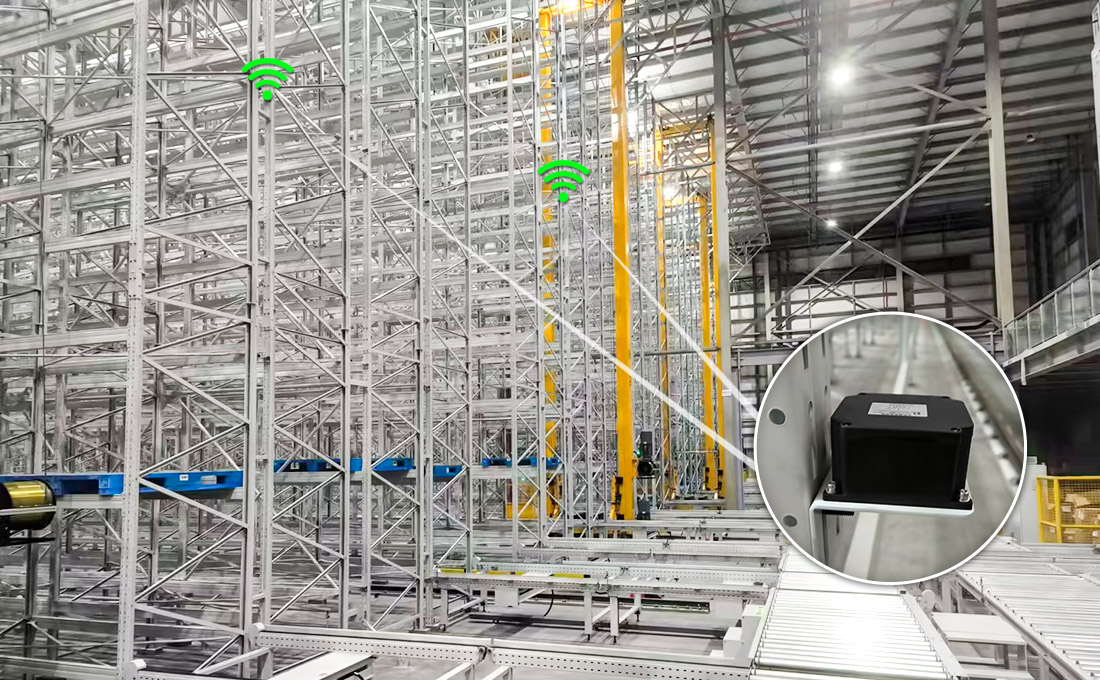
The project was driven by a fundamental industry shift: as warehouses move toward higher-density and taller rack configurations to maximize floor space utilization, the structural risks increase proportionally. Rack deformation caused by load exceeding design limits, uneven floor settlement, or impact from material handling equipment has become one of the most common safety incidents in modern logistics.
Key project data:
- Customer: Sinotrans Dongguan Supply Chain Management Co., Ltd.
- Location: Dongguan, Guangdong Province, China
- Application: Structural stability monitoring of automated high-bay warehouse racking
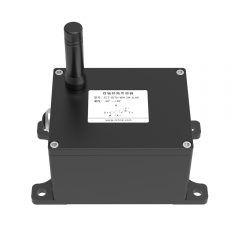
- Sensor: ZCT-IOTL-WN-2H-GM01 NB-IoT wireless tilt sensor
- Deployment scale: Regional warehouse network, full coverage
- Project year: 2025
2. The Challenge: Stability Risks in High-Density Warehousing
As Industry 4.0 and smart manufacturing accelerate, automated high-bay warehouses have become the backbone of modern logistics. These systems achieve dramatic space efficiency gains through tall racking structures, narrow aisles, and automated storage and retrieval systems.
However, this density introduces structural vulnerabilities:
- Rack deformation from cumulative load can progress undetected until a critical failure occurs
- Uneven floor settlement over time creates rack tilt that compromises stability
- Impact from forklifts and automated guided vehicles can shift rack alignment
- Manual inspection intervals leave long gaps between detection and action
Traditional inspection methods rely on periodic visual checks and manual measurement with levels or laser distance meters. These methods are labor-intensive, prone to human error, and cannot provide continuous monitoring coverage. By the time a problem is visible, damage may already be significant.
3. The Solution: NB-IoT Wireless Tilt Monitoring System
System Architecture
The deployed system consists of three integrated layers:
Layer 1 — Sensing: NB-IoT wireless tilt sensors (ZCT-IOTL-WN-2H-GM01) mounted at the top of each rack bay. The top position captures the maximum angular displacement, providing the earliest possible warning of developing deformation.
Layer 2 — Communication: Data transmitted via NB-IoT cellular network directly to the cloud platform. No local gateway or field wiring required. Communication latency below 200 ms, with support for over 10,000 concurrent terminal connections.
Layer 3 — Alerting: Three-tier alert mechanism: (1) local audible + visual alarm via wireless sounder/beacon (ZC-01HX-Y) for immediate on-site warning, (2) cloud dashboard visualization for operations center monitoring, (3) mobile app push notification for maintenance team dispatch.
Alert Threshold Logic
The system uses a configurable tilt threshold — typically set at ±0.5° for standard warehouse racking. When any sensor exceeds this threshold:
- On-site personnel receive immediate audible and visual alarm
- The operations center dashboard flags the affected rack location
- A push notification is sent to the maintenance team’s mobile device
- Historical trend data is displayed to help assess severity and urgency
4. Technical Specifications
The following table summarizes the key specifications of the deployed NB-IoT wireless tilt sensor:
| Parameter | Specification |
| Measurement axes | Dual-axis (X |
| Communication | NB-IoT (SIM-based |
| Latency | < 200 ms |
| Concurrent connections | Supports 10 |
| Alert threshold | Configurable (default ±0.5°) |
| Alert output | Local sounder/beacon (ZC-01HX-Y) + cloud + mobile app |
| Data transmission | Real-time |
| Mounting | Rack top position via bracket |
| Power | Battery-powered (long-life) |
| Network | Cellular NB-IoT (nationwide coverage) |
5. Results & Impact
Safety: Rack structural deformation incidents reduced by 92% after deployment. The continuous monitoring approach catches developing issues at an early stage, before they escalate into failures that could cause product damage or personnel injury.
Cost: Annual maintenance costs reduced by 35% through predictive maintenance. Instead of routine manual inspections at fixed intervals, the system enables condition-based maintenance — teams are dispatched only when the data indicates an issue.
Asset life: Equipment service life extended by an estimated 40%. Early detection of tilt trends allows corrective action (re-leveling, load redistribution, or structural repair) before permanent deformation sets in.
Operational efficiency: Zero disruption to warehouse operations. The wireless sensors were installed during normal operations without requiring rack unloading or area shutdown.
6. Key Takeaways for Engineers
- Top-mounted sensors catch problems earliest: Mounting tilt sensors at the top of each rack bay captures maximum angular displacement. The taller the rack, the more leverage amplifies small base movements into measurable tilt at the top.
- Multi-layer alerting prevents alert fatigue: A local alarm ensures immediate response for critical events, while dashboard and mobile alerts allow the operations team to prioritize. This layered approach avoids the common pitfall of relying on a single notification channel.
- NB-IoT is well-suited for large warehouse deployments: No gateway infrastructure is needed, making deployment scalable across multiple warehouse sites. The cellular connection is reliable, low-power, and supported by existing infrastructure.
- Threshold calibration matters: The ±0.5° default threshold should be adjusted based on rack height, bay depth, and stored material type. Taller racks or racks storing fragile goods may need tighter thresholds.
7. Frequently Asked Questions
- How does the sensor communicate if the warehouse has thick concrete walls and metal racking?
The ZCT-IOTL-WN-2H-GM01 uses NB-IoT cellular technology, which operates on licensed LTE bands designed for deep indoor penetration. The signal passes through concrete walls and metal racking reliably. No local gateway, repeater, or signal booster is required in typical warehouse environments.
- Can the same system work across multiple warehouse locations?
Yes. Because each sensor connects independently to the cellular network, there is no geographic limitation. A single cloud platform can aggregate data from sensors in multiple warehouses, cities, or countries, providing centralized visibility across an entire logistics network.
- How is the alarm threshold calibrated for different rack types?
The threshold is configurable remotely via the cloud platform. For standard selective racking (8–12 m height), ±0.5° is a common starting point. For drive-in racking, narrow-aisle racking, or racks storing fragile goods, tighter thresholds (e.g., ±0.2°) may be set. Historical trend data can help fine-tune the threshold after the first weeks of operation.
- What happens if the sensor battery dies in an inaccessible location?
The sensor is designed with a multi-year battery life. The low-power NB-IoT protocol and optimized reporting intervals ensure long operational life. The cloud platform tracks each sensor’s battery level and provides advance warning when replacement is needed, so it can be scheduled during routine maintenance.
TAG: