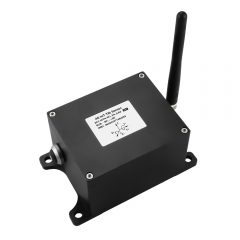
1. Project Overview
The MRT Orange Line is one of Bangkok’s most ambitious public transit expansions. The eastern section, currently under construction, connects the city center to emerging residential districts in the east, with a planned opening in 2028. The scope includes twin-bore tunnels (6.3 m diameter), multiple underground stations, ventilation shafts, and cut-and-cover tunnel sections.
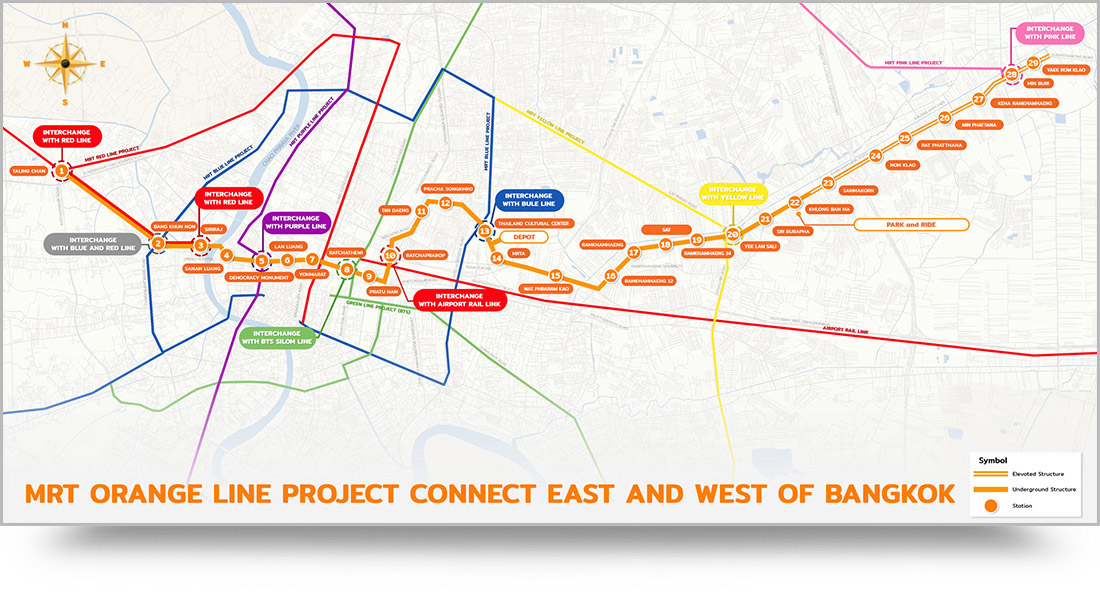
The line traverses some of Bangkok’s busiest road corridors, passing beneath major intersections and alongside canals that require temporary or permanent rerouting. One station is built directly beneath an existing highway interchange, adding further complexity to an already challenging urban construction environment.
Key project data:
- Route: MRT Orange Line East Section (Thailand Cultural Centre – Min Buri)
- Contractor: China Railway Construction Corporation (CRCC)
- Tunnel method: Shield TBM with twin 6.3 m diameter bores
- Completion target: 2028
- Monitoring requirement: Wireless tilt monitoring of surface structures along the tunnel alignment
2. The Challenge: Complex Geology in Dense Urban Terrain
During underground station excavation, one of the greatest risks is ground instability. Geotechnical investigations revealed a critical concern: gaps existed within the second layer of stiff clay. These voids create a pathway for water from the underlying aquifer sand layer to flow upward, potentially destabilizing the excavation face and surrounding ground.
To ensure construction safety, the monitoring team needed a reliable tilt monitoring system installed on buildings and structures along the tunnel alignment. The approach involved mounting aluminum rods in series on ground-level structures, with wireless tilt sensors fixed at the midpoint of each rod. These sensors transmit X and Y axis inclination data at configurable intervals to the monitoring server.
By plotting this data, engineers can detect early signs of ground settlement or structural movement and take corrective action before damage occurs.
Three key constraints drove the technology choice:
- Site conditions made wired installations impractical — running cables across busy Bangkok roads was neither safe nor cost-effective
- Sensors needed to transmit data reliably through a dense urban environment with buildings, vehicles, and pedestrian traffic
- Battery-powered operation was essential, as grid power was not available at every monitoring point
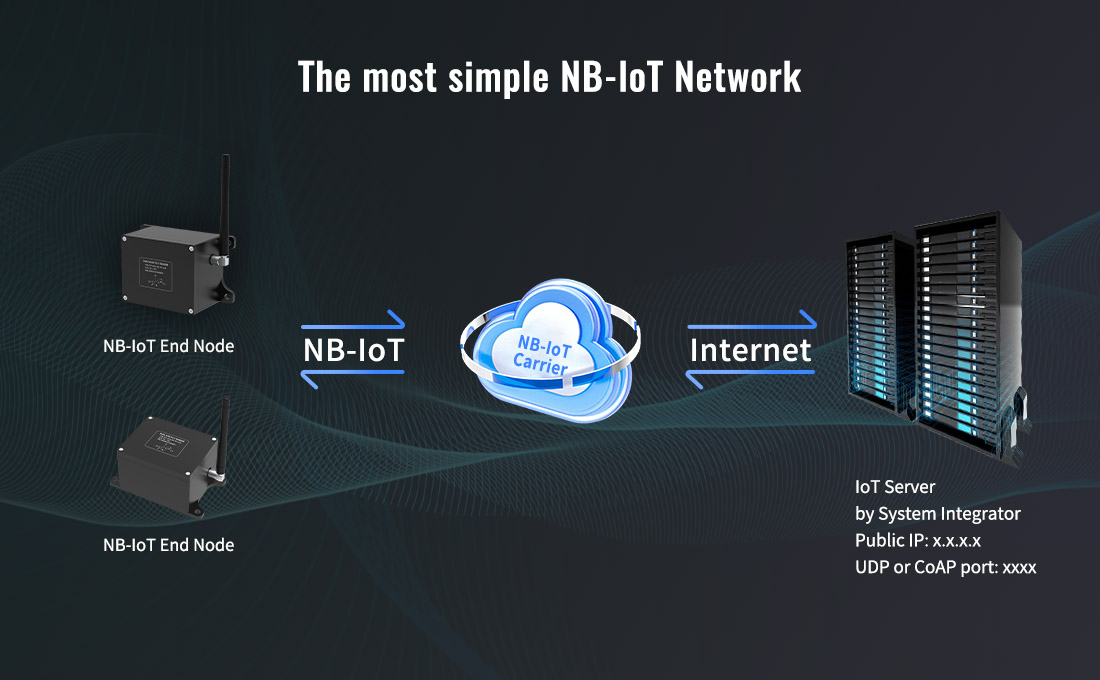
3. The Solution: Three Generations of Wireless Technology
Phase 1: LoRaWAN (2019)
ZC Sensor originally deployed LoRaWAN-based wireless tilt sensors for this project in 2019. The LoRa sensors communicated with local gateways, which then forwarded data to the cloud. While LoRaWAN offers excellent low-power characteristics, field experience revealed a practical limitation: communication between LoRa sensors and their gateways was highly susceptible to environmental obstructions. Pedestrians, vehicles, and other temporary obstacles frequently disrupted the radio link, causing data gaps.
Phase 2: NB-IoT
To overcome the reliability issue, ZC Sensor developed an NB-IoT version. By inserting a SIM card directly into each sensor, the device connected to the cellular network without requiring a local gateway. This eliminated the line-of-sight dependency and dramatically improved data reliability. The monitoring team adopted this solution and reported excellent results: stable data transmission, simplified deployment, and robust performance in harsh urban conditions.
Phase 3: 4G CAT1 (2024–Present)
As cellular infrastructure in Southeast Asia continued to evolve, a new trend emerged: telecom operators began phasing out NB-IoT support. Starting in 2024, Thai carriers notified customers that NB-IoT services would be progressively discontinued. The project team reached out to ZC Sensor for an upgraded solution.
ZC Sensor responded with a 4G CAT1-based wireless tilt sensor, released in late 2024. CAT1 is a streamlined variant of 4G LTE that offers an optimal balance of power efficiency and data rate — far more suitable for IoT sensor applications than standard 4G CAT4, which is designed for smartphones and consumes significantly more power.
The CAT1 sensors were deployed and have been operating reliably since installation.
4. Technical Specifications
The following table summarizes the key specifications of the 4G CAT1 wireless tilt sensor deployed on this project:
| Parameter | Specification |
| Measurement axes | Dual-axis (X, Y), optional triple-axis |
| Resolution | 0.001° |
| Accuracy | 0.005° to 0.01° |
| Measurement range | Up to ±90° (selectable) |
| Communication | 4G CAT1 with MQTT protocol |
| Data storage | Built-in TF card; automatic data retransmission on network recovery |
| Battery life | Up to 4.5 years at 1 report/hour |
| Alarm | Real-time alarm with remotely configurable threshold |
| Enclosure | Aluminum alloy, IP67 rated |
| Operating temperature | −40°C to +80°C |
| Deployment | Simple bolt-on installation, no field wiring required |
5. Results & Impact
Reliability: The CAT1 sensors have delivered stable, uninterrupted data transmission since deployment, eliminating the communication dropouts experienced with the earlier LoRaWAN system.
Deployment efficiency: No field wiring or gateway installation was required. Sensors were mounted directly onto aluminum rods on site and began transmitting within minutes of power-on.
Data integrity: Built-in onboard storage ensures that no data is lost during temporary network outages. Once connectivity is restored, the sensor automatically retransmits all missed data points.
Remote configurability: Alarm thresholds and reporting intervals can be adjusted remotely, eliminating the need for site visits for routine configuration changes.
6. Key Takeaways for Engineers
This project offers several practical lessons for engineers selecting wireless monitoring solutions:
- Gateway-dependent vs. gateway-free: LoRaWAN can be cost-effective in open environments, but in dense urban settings with dynamic obstructions, cellular-based solutions (NB-IoT or CAT1) offer superior reliability. Always evaluate the physical deployment environment before choosing a protocol.
- Plan for technology migration: Cellular IoT standards evolve rapidly. NB-IoT networks are already being phased out in some regions. Choosing a sensor platform that supports multiple communication protocols—or is easily upgradeable—protects your investment.
- Data redundancy matters: Onboard data storage with automatic retransmission is not a luxury feature. In real-world deployments, network interruptions are inevitable. A sensor that buffers and retransmits data saves months of manual data recovery work.
- Power budgeting: A battery life of 4.5 years at hourly reporting intervals is achievable with proper power management. When evaluating specifications, verify that battery life claims are based on real-world reporting intervals, not idealized laboratory conditions.
7. Frequently Asked Questions
- Why did the project move from LoRaWAN to cellular-based communication?
In the dense urban environment of Bangkok, LoRaWAN signals were frequently blocked by passing vehicles, pedestrians, and buildings. The NB-IoT and later CAT1 cellular alternatives bypass this issue by connecting directly to the mobile network, eliminating the gateway as a single point of failure.
- What makes CAT1 different from standard 4G?
CAT1 is a lower-bandwidth variant of 4G LTE optimized for IoT applications. Whereas standard 4G (CAT4) is designed for high-bandwidth applications like video streaming, CAT1 offers adequate data rates for sensor telemetry at a fraction of the power consumption, making it ideal for battery-powered field devices.
- How long does installation take per sensor?
The sensor mounts directly onto the monitoring rod or structure using included brackets. Typical installation takes 10–15 minutes per unit, including mechanical mounting and power-on verification. No wiring, gateway pairing, or network configuration is required at the deployment site.
- What happens if the cellular network is temporarily unavailable?
The sensor is equipped with onboard flash storage that continuously buffers measurement data. When network connectivity is restored, the sensor automatically uploads all buffered data in chronological order, ensuring a complete data record without manual intervention.
TAG: