Summary
A well-known French geotechnical monitoring company ran several months of field testing on the ZCT-CX300 in-place inclinometer before approving it and integrating it into its own monitoring platform. After validation, the customer placed a bulk order of hundreds of IPI probes for the biggest European express project at the time. The decisive factors were the probe’s dual-axis high-accuracy design, all-stainless-steel body, waterproofing tested to 150 m water depth, single-cable addressable networking, and Modbus open protocol, which together support large-scale, unattended slope and embankment monitoring.
1. Project Overview
A well-known French geotechnical monitoring company ordered hundreds of in-place inclinometer (IPI) probes from Zhichuan Technology for the biggest European express project at the time. The order marked one of the largest single deliveries of IPI probes in the company’s export history.
Before placing the bulk order, the French customer ran several months of field testing on the ZCT-CX300 in-place inclinometer. Only after the probes passed their evaluation was the product approved and integrated into the customer’s own monitoring platform.
Key project data:
| Parameter | Detail |
| Customer | A well-known French geotechnical monitoring company |
| Order scope | Hundreds of IPI probes (bulk quantity) |
| Project | The biggest European express project |
| Product | ZCT-CX300 In-Place Inclinometer (IPI) |
| Validation | Several months of field testing before approval |
| Integration | Probes approved and integrated into the customer’s monitoring platform |
| Publication date | July 2020 |
2. Why a Monitoring Company Needs an IPI Supplier It Can Trust
In-place inclinometers are typically deployed in landslide, embankment, and other remote or dangerous site monitoring scenarios. For a geotechnical monitoring company serving a continent-scale express project, the stakes are high:
Reliability in remote locations. Monitoring sites are often far from power and staff. Probes must run continuously, unattended, and survive harsh environmental conditions.
Easy field assembly. Huge projects demand fast, simple installation by field crews. Complicated assembly multiplies cost and error risk across hundreds of boreholes.
Data that fits an existing platform. The customer had its own monitoring platform. Sensors had to speak open protocols and integrate cleanly, not lock the customer into a proprietary ecosystem.
Bulk supply consistency. An order of hundreds of probes means every unit must perform identically. Production consistency is as important as the specification sheet.
3. The Solution: ZCT-CX300 In-Place Inclinometer
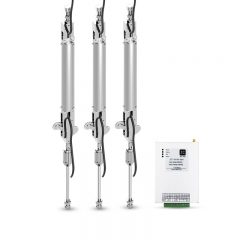
The ZCT-CX300 in-place inclinometer is a dual-axis, high-accuracy probe designed specifically for landslide, embankment, and other remote and dangerous site monitoring. It is the product line the French customer evaluated and ultimately standardized on.
Key features of the ZCT-CX300:
| Feature | Benefit |
| Dual-axis, high-accuracy probe | Measures both axes of inclination in one unit, reducing borehole hardware |
| All stainless steel structure | Robust and durable for long-term outdoor and buried installation |
| Waterproof tested to max 150 m water depth | Each probe individually tested; suitable for submerged boreholes and high groundwater |
| Addressable probe, single cable required | Multiple probes daisy-chain on one cable, dramatically cutting cabling cost and installation time |
| Modbus open protocol | Standard industrial protocol; easy data collection and network integration |
| Real-time monitoring | Saves labor and time in bad-environment usage |
| Remote control and data acquisition | Unattended operation for remote and dangerous sites |
| Vertical and horizontal configurations | Two types cover both borehole and horizontal applications |
4. How the Customer Validated and Integrated the Product
The path from sample evaluation to a bulk order was deliberately rigorous. The French customer spent several months testing the ZCT-CX300 before any commitment:
- Evaluation phase. The customer tested the probes under field conditions, verifying measurement stability, waterproofing, and long-term reliability.
- Approval. After the evaluation period, the ZCT-CX300 was formally approved by the customer.
- Platform integration. The probes were integrated into the customer’s own monitoring platform, meaning the customer’s engineers receive and process data through tools they already use.
- Bulk deployment. With approval and integration complete, the customer ordered hundreds of probes for the biggest European express project.
5. Key Takeaways for Engineers
Open protocols win large projects. Modbus-based probes integrate with existing monitoring platforms without custom middleware. In multi-year infrastructure projects, protocol openness directly reduces integration risk.
Testing builds trust before the big order. Reputable monitoring companies qualify suppliers with extended field tests. Manufacturers should expect a multi-month evaluation cycle and provide samples, test support, and consistent production quality.
Addressable design scales. Single-cable, addressable probes keep installation simple and cost predictable when a project calls for hundreds of measurement points.
Waterproofing is non-negotiable. Borehole and embankment environments involve groundwater. A 150 m water-depth tested, stainless steel probe removes a major failure mode.
6. Frequently Asked Questions
What is an in-place inclinometer (IPI)? An in-place inclinometer is a fixed probe installed permanently in a borehole or structure to continuously measure inclination. Unlike portable inclinometers that are manually lowered into a casing, IPIs stay in place and report data in real time, making them ideal for unattended monitoring of slopes, embankments, and structures.
Where are ZCT-CX300 IPIs typically used? The ZCT-CX300 is designed for landslide, embankment, and other remote or dangerous site monitoring, where continuous unattended data is needed. Typical applications include slope stability monitoring, embankment settlement, and ground movement monitoring around large infrastructure projects.
Why is a single-cable addressable design important for large projects? With addressable probes, multiple sensors share one cable and are identified by their address. For projects with hundreds of measurement points, this reduces cabling cost, simplifies installation, and shortens deployment time significantly.
What communication protocol does the ZCT-CX300 use? The ZCT-CX300 uses the Modbus open protocol, which is widely supported by data loggers, SCADA systems, and monitoring platforms. This makes data collection straightforward and allows easy integration into a customer’s existing monitoring infrastructure.
TAG: