
Summary: MEMS tilt sensors are the right choice for most structural monitoring projects: they offer adequate resolution (0.001°–0.01°), excellent vibration and shock tolerance, low power consumption suitable for wireless deployments, and a wide measurement range at moderate cost. Electrolytic sensors deliver higher resolution (down to 0.0001°) and lower noise for static, very slow measurements in stable environments such as dam foundations, but they have narrower ranges, higher temperature sensitivity, and higher power draw. Select MEMS for vibration-prone structures and wireless projects; select electrolytic only where sub-milli-degree resolution on a rigid, stable structure is genuinely required.
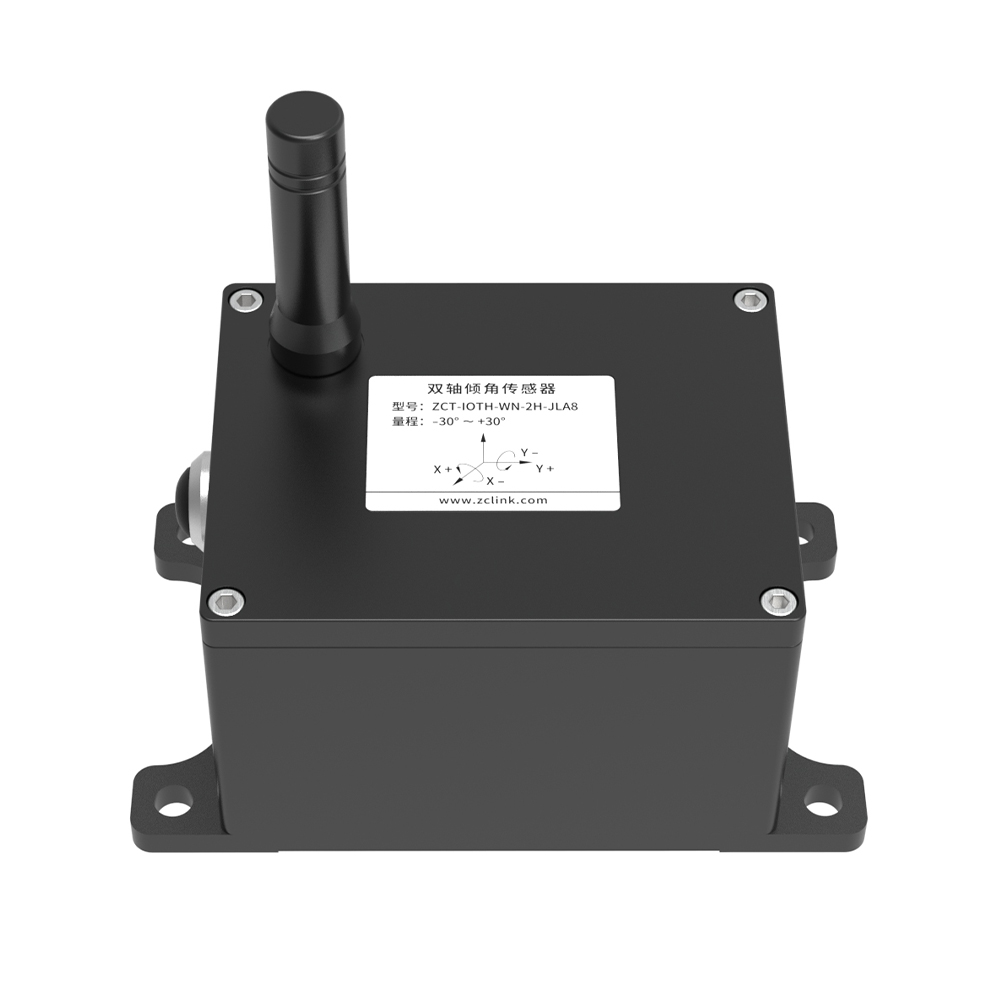
1. Why the Technology Choice Matters
The sensing technology inside a tiltmeter determines more than its resolution. It affects battery life, tolerance to vibration and shock, temperature stability, measurement range, and unit cost — all of which directly influence whether a monitoring system performs in the field.
Two sensing principles dominate structural and geotechnical monitoring today: MEMS (micro-electromechanical systems) accelerometer-based tilt sensors and electrolytic (liquid-cell) tilt sensors. A third family, force-balance servo tiltmeters, reaches the highest precision but at 10–50× the cost of MEMS and is reserved for geophysical and reference applications.
This guide compares MEMS and electrolytic technologies from an engineer’s perspective and provides a decision framework based on the structure being monitored and the deployment conditions.
2. How Each Technology Works
MEMS Tilt Sensors
A MEMS tilt sensor contains a silicon microstructure — a small proof mass suspended by micro-machined springs. Under gravity, the mass deflects, and the deflection is measured as a change in capacitance between the moving mass and fixed electrodes. Because gravity is the only static acceleration, the sensor output is directly proportional to the tilt angle projected onto its measurement axis.
- Typical resolution: 0.001° to 0.01° (model dependent)
- Residual thermal drift: 10–50 µrad/°C after factory compensation
- Power: microwatt range during sleep — supports multi-year wireless battery life
- Vibration/shock tolerance: very high; survives acceleration well beyond measurement range
- Measurement range: wide, up to ±90° per axis
- Cost: low to moderate, especially at volume
Electrolytic Tilt Sensors
An electrolytic sensor is a sealed glass or ceramic cavity partially filled with a conductive liquid and fitted with multiple electrodes. When the sensor tilts, the liquid redistributes and the impedance between electrode pairs changes. The reading is differential, typically driven by an AC excitation signal.
- Typical resolution: down to 0.0001° in high-end models
- Low-frequency noise: extremely low — the fluid mechanically averages high-frequency disturbances
- Temperature sensitivity: 0.01–0.1% of full scale per °C (varies with electrolyte composition)
- Power: higher than MEMS due to continuous AC excitation
- Measurement range: typically ±1° to ±45° (narrow-range variants ±1° to ±10°)
- Cost: medium to high
3. Side-by-Side Comparison
| Parameter | MEMS | Electrolytic |
| Resolution | 0.001°–0.01° (typical) | Down to 0.0001° (high-end) |
| Low-frequency noise | Moderate | Very low (fluid integrates high frequencies) |
| Temperature stability | 10–50 µrad/°C after compensation | 0.01–0.1% FS per °C; needs individual calibration |
| Measurement range | Up to ±90° per axis | ±1° to ±45° (typical) |
| Power consumption | Very low (wireless-friendly) | Higher (continuous AC excitation) |
| Vibration / shock tolerance | High | Low — shocks can damage seals |
| Output | Digital (RS485 | Modbus |
| Maintenance | Minimal — solid-state | Electrolyte ages; seals degrade over time |
| Relative cost | Low to moderate | Medium to high |
| Best fit | Vibration-prone structures | wireless projects |
4. Decision Framework
Choose MEMS when:
- The structure is subject to vibration — bridges under traffic, buildings with mechanical systems, machine foundations
- Wireless deployment and multi-year battery life are required
- The measured phenomenon is comfortably above the sensor noise floor (typical structural monitoring)
- A wide measurement range is needed (e.g., slope monitoring with potentially large movements)
- Cost and deployment simplicity are key constraints
Choose Electrolytic when:
- The application requires sub-milli-degree resolution on a rigid, stable structure
- The environment is stable and temperature-controlled (e.g., laboratory structural tests, dam foundations)
- Measurements are static or very slow over long periods, and noise floor is the critical factor
- AC power or frequent battery replacement is acceptable
Consider Force-Balance Servo when:
- The signal of interest is at the nanoradian level — tectonic monitoring, volcano deformation, scientific instrumentation
- Budget and power constraints permit a high-end instrument (10–50× the cost of MEMS)
5. Lessons from the Field
- Finest resolution is not always the priority: A sensor with 0.0001° resolution is wasted on a deteriorating bridge where the structural phenomenon is orders of magnitude larger than the noise floor. Match the technology to the phenomenon, not to the best datasheet number.
- Temperature stability drives long-term decisions: Electrolytic sensors need individual temperature compensation for precision work. MEMS sensors are factory-compensated and generally more predictable across wide outdoor temperature swings — an advantage for exposed outdoor installations.
- Power budget decides wireless feasibility: Electrolytic sensors consume more power due to continuous AC excitation. If your project requires battery-powered wireless tilt monitoring over years, MEMS is usually the enabling technology.
- Maintenance cost is part of total cost: Electrolyte aging and seal degradation add maintenance burden over a multi-year deployment. MEMS solid-state construction offers a simpler lifecycle.
6. Frequently Asked Questions
- Can MEMS sensors achieve the same resolution as electrolytic sensors?
No. High-end electrolytic sensors reach 0.0001° resolution, while commercial MEMS tilt sensors typically deliver 0.001°–0.01°. However, for most structural monitoring applications, the practical resolution needed is well above both noise floors, so this difference rarely determines the correct choice.
- Why do electrolytic sensors drift with temperature?
Electrolytic sensors depend on the physical properties of a conductive liquid — viscosity and conductivity change with temperature. This produces zero and scale changes typically in the range of 0.01–0.1% of full scale per °C. Precision applications require individual calibration and temperature compensation tables.
- Are MEMS sensors suitable for dam foundation monitoring?
It depends on the required resolution. For very slow, ultra-precise deformation monitoring on dam foundations, electrolytic or force-balance sensors may be preferred due to their lower noise floor. For general dam safety monitoring where movements are in the milli-degree range or larger, MEMS sensors are widely used and cost-effective.
- Which technology supports wireless, battery-powered monitoring?
MEMS is the clear choice for wireless deployments. Its microwatt sleep power supports multi-year battery life, which is why wireless tilt sensor families (e.g., LoRaWAN, NB-IoT, 4G CAT1) are built on MEMS technology. Electrolytic sensors’ continuous AC excitation drains batteries far faster.
TAG: