
Summary: For remote tilt monitoring, choose LoRaWAN for open, low-density sites where you can deploy and maintain gateways; choose NB-IoT or 4G CAT1 for dense urban environments where gateway radio paths are unreliable. 4G CAT1 offers the highest reliability and the most mature, future-proof ecosystem, at a higher module cost and moderate power consumption. Battery life, latency, and gateway dependency are the three key trade-offs to evaluate against your deployment environment.
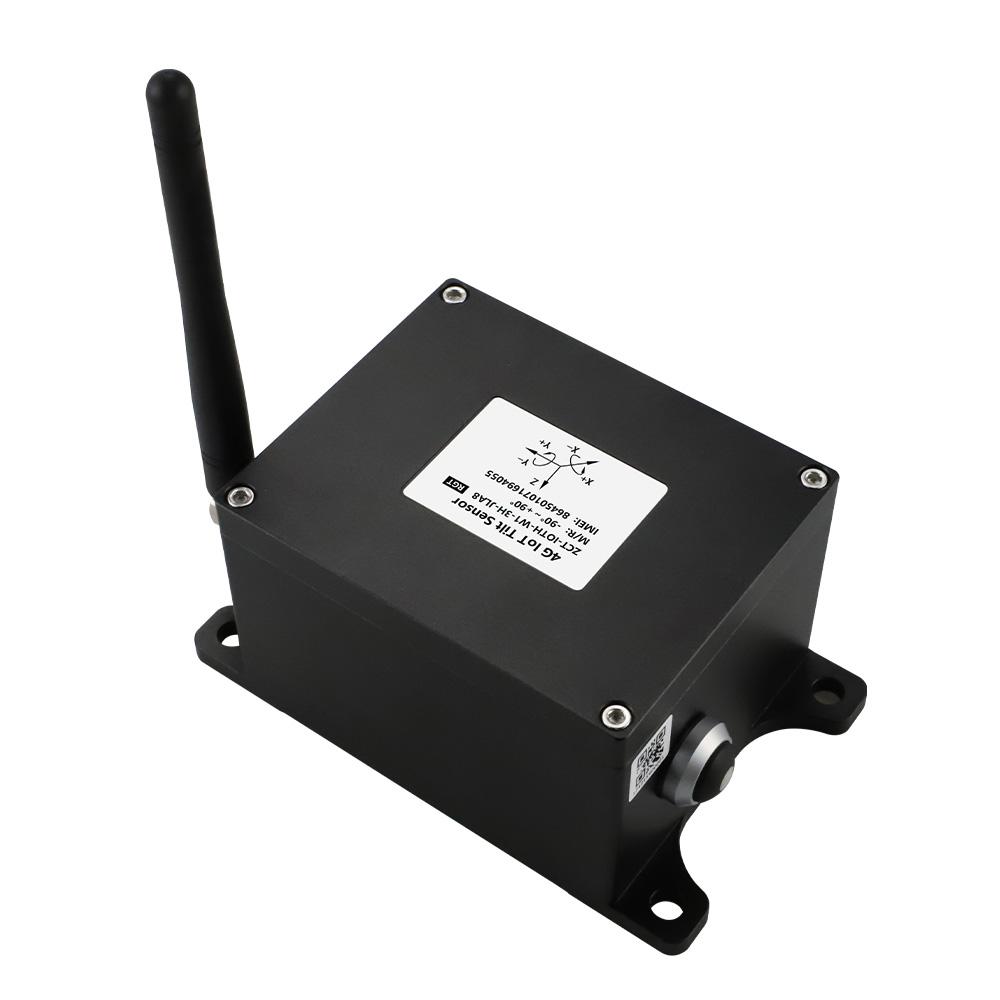
1. Why the Protocol Choice Matters
In any remote monitoring project, the wireless communication protocol is often the deciding factor between a system that works and one that fails in the field. A tilt sensor can have excellent accuracy and stability, but if its data cannot reach the engineer reliably, the entire system loses value.
Three protocols dominate the IoT tilt sensor landscape today: LoRaWAN, NB-IoT, and 4G CAT1. Each has distinct trade-offs in range, power, reliability, and infrastructure requirements. Selecting the wrong one can lead to recurring data gaps, higher operational costs, or premature system replacement.
This guide provides a practical, engineer-focused comparison of these three protocols and a decision framework for structural and geotechnical monitoring projects.
2. Protocol Overview
LoRaWAN
LoRaWAN (Long Range Wide Area Network) is an LPWAN technology operating in unlicensed ISM bands — 868 MHz in Europe, 915 MHz in North America, and 470–510 MHz (CN470) in China. It uses chirp spread spectrum modulation to achieve long-range communication at very low power.
- Frequency: Unlicensed ISM bands (regional variations)
- Data rate: Very low (0.3–50 kbps)
- Architecture: Star-of-stars network (sensor → gateway → network server)
- Power: Extremely low (multi-year battery life)
- Range: 2–15 km line-of-sight; heavily reduced in dense urban areas
- Key limitation: Gateway-dependent — requires local infrastructure deployment
NB-IoT
NB-IoT (Narrowband IoT) is a 3GPP-standardized LPWAN technology that operates in licensed cellular spectrum. It was designed specifically for IoT applications requiring low data rates, deep indoor penetration, and carrier-grade reliability.
- Frequency: Licensed LTE bands (in-band, guard-band, or standalone)
- Data rate: Low (20–250 kbps)
- Architecture: Direct to cellular base station (no gateway required)
- Power: Low (multi-year battery life, reporting-interval dependent)
- Coverage: Carrier network footprint with good urban penetration
- Key advantage: Gateway-free — SIM-based authentication and direct connectivity
4G CAT1
CAT1 is a 3GPP UE category for 4G LTE supporting moderate data rates (up to 10 Mbps downlink / 5 Mbps uplink) at significantly lower power than broadband 4G (CAT4/CAT6). It fills the gap between LPWAN and full-speed LTE.
- Frequency: Licensed LTE bands (standard 4G spectrum)
- Data rate: Medium (up to 10 Mbps downlink)
- Architecture: Direct to cellular base station (no gateway required)
- Power: Moderate (typically 1–4.5 years depending on reporting interval)
- Coverage: Mature 4G infrastructure worldwide
- Key advantage: Highest reliability, faster data rate, and a mature, future-proof standard
3. Side-by-Side Comparison
| Parameter | LoRaWAN | NB-IoT | 4G CAT1 |
|---|---|---|---|
| Frequency band | Unlicensed ISM | Licensed LTE | Licensed LTE |
| Data rate | 0.3–50 kbps | 20–250 kbps | Up to 10 Mbps |
| Gateway required? | Yes | No | No |
| Battery (1h report) | 5–8 yrs typical | 3–5 yrs typical | 1–4.5 yrs |
| Latency | High (1–10 s) | Medium (1–10 s) | Low (50–100 ms) |
| Urban penetration | Poor–moderate | Good | Excellent |
| Carrier phase-out risk | Low (unlicensed) | Medium (some regions) | Low (mature) |
| Module cost | $ | $$ | $$$ |
| Best for | Open areas / low density | Urban / mid density | Urban / high reliability |
4. Decision Framework: Which Protocol Fits Your Project?
Scenario 1: Open, remote sites (mines, slopes, rural infrastructure)
LoRaWAN is often the pragmatic choice where gateways can be deployed and radio line-of-sight is available. In mining or slope monitoring with an on-site data center, a gateway within range of sensors provides low-cost, long-battery monitoring. The trade-off is that you own and maintain the gateway infrastructure.
Scenario 2: Dense urban environments (metro construction, buildings, bridges)
NB-IoT or 4G CAT1 are the better options. Gateway-dependent protocols struggle where buildings, vehicles, and pedestrian traffic dynamically obstruct radio paths. Cellular connectivity eliminates the gateway as a single point of failure and provides direct-to-cloud transmission. This was the exact finding of a Bangkok metro monitoring project, where the deployment evolved from LoRaWAN to NB-IoT and finally to 4G CAT1 over five years to achieve reliable data in a dense urban corridor.
Scenario 3: Cross-region or future-proof deployments
If sensors must roam across regions or you want protection against local network technology phase-outs, 4G CAT1 offers the most mature ecosystem. Some regions have begun discontinuing NB-IoT support, so carriers are migrating IoT devices to 4G-based alternatives. A protocol-agnostic sensor platform — one that can support multiple communication modules — protects your hardware investment either way.
5. Lessons from the Field
1. Gateway dependency is the hidden risk: In open environments gateways work well; in dynamic urban settings they become a reliability bottleneck. Always simulate the physical deployment environment before committing to a protocol.
2. Power claims need context: Battery life figures are only meaningful relative to reporting interval. A sensor reporting every hour consumes far more than one reporting daily. Compare like-for-like when evaluating vendors.
3. Data buffering is non-negotiable: Network interruptions are inevitable in real deployments. Choose sensors with onboard storage and automatic retransmission to avoid data gaps.
4. Plan for technology migration: Cellular IoT standards evolve quickly. Selecting a sensor family that supports multiple protocols (LoRaWAN, NB-IoT, CAT1) or offers upgrade paths preserves your investment as networks change.
6. Frequently Asked Questions
Is LoRaWAN always cheaper than cellular options?
Not necessarily. While LoRaWAN modules are cheaper than 4G CAT1 modules, you must factor in gateway hardware, gateway maintenance, and the cost of site visits to troubleshoot connectivity issues. In dense urban deployments, the total cost of ownership of a cellular solution can be lower because it eliminates gateway infrastructure and related maintenance.
Can a sensor support multiple protocols?
Yes. Some sensor families are designed with interchangeable communication modules, allowing the same sensing platform to run LoRaWAN, NB-IoT, or 4G CAT1 depending on project requirements. This flexibility is valuable when deploying across multiple sites with different network conditions.
How do I estimate battery life for my reporting interval?
Battery life scales inversely with reporting frequency and data volume. As a rule of thumb, increasing the reporting interval tenfold (e.g., from 10 minutes to 100 minutes) extends battery life severalfold. Always request battery life curves at your specific interval rather than relying on headline figures.
What happens if the cellular network is down temporarily?
Sensors with onboard storage buffer all measurements during the outage. When connectivity returns, buffered data is uploaded automatically in chronological order, ensuring a complete data record. Verify this capability exists before purchasing.
TAG: